
You step off the train, or out of the airport, into a city you have only seen in photographs. The signs point in directions you cannot yet read with confidence, and you have three days to make sense of it all. That first hour feels exciting and overwhelming at once, and the difference between a trip that feels rushed and one that feels satisfying usually comes down to the plan you made before you arrived. A good three-day itinerary does not try to cover everything. It gives each day a clear shape.
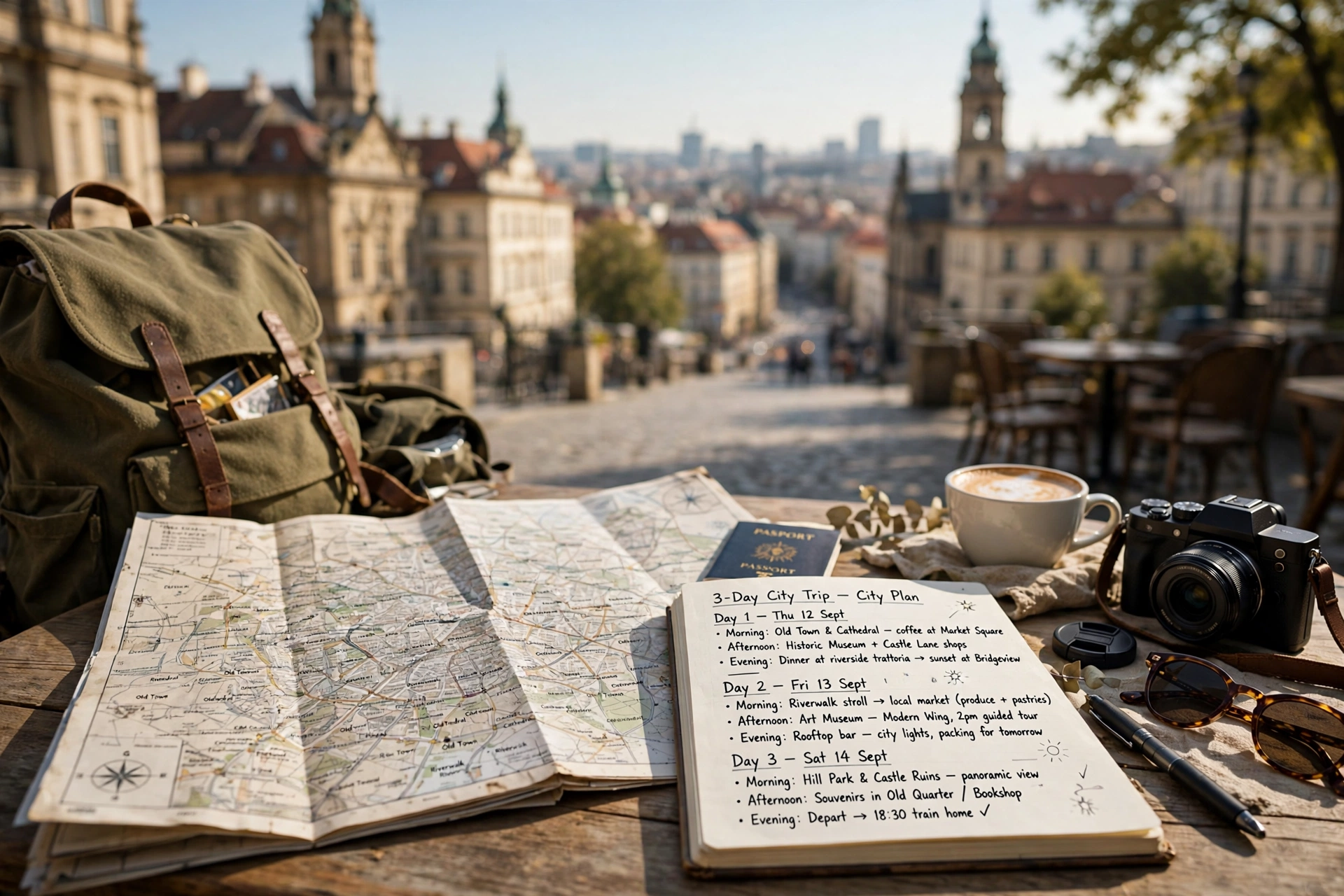
Start With One Base, Not a Long Checklist
The most common mistake first-time visitors make is choosing sights first and accommodation second. Reverse that order. Pick one central neighbourhood to stay in, safe to walk around in the evening and close to public transport, so most of what you want to see is reachable within about half an hour. It also gives you a familiar street to return to when you are tired.
Once your base is set, list the places you genuinely want to see, not the places you feel you ought to see. A useful test is simple: if you could only tell one story about this city when you got home, which place would it come from? Put those two or three places at the top. Everything else is a bonus. Group your list by area on a map, because three sights in the same neighbourhood make a far better day than three famous sights scattered across the city.
Give Each Day a Different Job
Three days work best when each day has its own purpose. Trying to do a little of everything every day is how trips turn into a blur.
Day one is for orientation. Walk the central area, find the main square or waterfront, and eat somewhere local rather than somewhere famous. You are learning the city’s rhythm: how busy the streets get, where to buy water and a transport ticket. A single well-paced day in one place, such as a one-day visit to Kyoto, shows how much ground you can enjoyably cover when you keep the route compact instead of chasing sights across town.
Day two is for depth. This is the day for the museum, historic site, market, or neighbourhood you most wanted to see. Go early if it is popular, and give it the time it deserves rather than squeezing a second major sight in right after it. The afternoon can be slower: a park, a cafe, or a street you noticed on day one and wanted to explore properly.
Day three is for favourites and loose ends. Revisit the place you liked most, pick up anything you missed, and leave the last few hours deliberately unscheduled, to cover a delayed train, a return visit, or a long final lunch.
Choose What Makes the Cut
With only three days, saying no is part of planning. For each candidate sight, ask three questions. Does it match why you came? How much time does it really take, including travel and queues? And can it be combined with something nearby? If it cannot, it needs to be important enough to justify a separate trip.
Keep your daily list short: one major sight, one or two smaller stops, and one good meal you are looking forward to. That is a full day. Anything beyond that is optional, and treating it as optional removes the pressure that spoils so many short trips. First-time visitors to Bali face the same choice: a few well-chosen stops, grouped by area, beat a long list spread across the whole map.
Build Travel Time, Meals, and Rest Into the Plan
Itineraries usually fail on the gaps between sights, not on the sights themselves. Before you finalise a day, check how long each journey takes, and add a buffer of at least fifteen minutes for finding the right stop or walking more slowly than you expected. Two sights that look close on a map can be separated by a river, a hill, or a one-way system that doubles the walk.
Meals deserve the same planning as sights. Decide roughly where you will eat lunch each day, especially on day two when you will be inside a large attraction. A planned lunch stop is not a luxury; it is what keeps the afternoon enjoyable. Plan one proper rest each day too, whether that is a cafe break, a park bench, or an hour back at your accommodation. Rest is not wasted time on a short trip. It is what lets you enjoy the evening instead of collapsing before dinner.
Book Only What Truly Needs Booking
Not everything needs a ticket in advance, and over-booking is the fastest way to turn a holiday into a timetable. Book only what genuinely sells out or has fixed entry times: a very popular attraction, a guided tour you specifically want, or a restaurant you would be disappointed to miss. For everything else, keep your options open.
When you do book, keep all confirmations in one place on your phone, with addresses and entry times written out in full. Screenshot the important ones in case you lose signal. Check the opening hours and any weekly closing day for each major sight before you travel, because a museum closed on Mondays can quietly undo a whole day’s plan. A quick check of the attraction’s own official page is worth more than a dozen general guides.
A Workable Day-by-Day Template
You do not need a minute-by-minute schedule. A loose template for each day is enough, and you can adapt it to any city:
- Morning: one major sight, starting early, with a coffee stop on the way.
- Midday: lunch near that sight, then a short walk or a smaller stop in the same area.
- Afternoon: one neighbourhood, market, park, or second sight, at a relaxed pace.
- Evening: dinner near your base, plus one low-effort pleasure such as a viewpoint, a night market, or a stroll along the water.
Write the template down, but hold it lightly. If a place captures your attention, stay longer and drop something smaller. The template exists to prevent the aimless feeling of not knowing what to do next, not to punish you for enjoying yourself.
When Plans Go Wrong
Something on a three-day trip will go differently from the plan. Rain will arrive, a sight will be closed for renovation, or you will simply be more tired than you expected. Keep a backup for each day, such as a covered market or an indoor gallery, so these moments stay manageable. If you fall behind, drop the least important stop, not the rest break.
It also helps to learn the transport basics before you arrive: how tickets are bought, whether the system uses tap-in and tap-out, and roughly what a day ticket costs. Ten minutes of reading about this at home saves an hour of confusion at a busy station.
FAQ
How many sights should I plan per day?
One major sight and one or two smaller stops is plenty. Three major attractions in a single day usually means rushing all three and enjoying none of them.
Should I stay in one place for all three days?
Yes, in almost every case. Changing hotels during a three-day trip costs you packing, checking out, travelling, and checking in again, which is usually half a day lost.
What if I arrive late on the first day?
Treat arrival day as a bonus, not day one. Eat near your base, take a short evening walk to get your bearings, and start the three-day shape the next morning.
Do I need a guided tour as a first-time visitor?
Not necessarily. A short walking tour on day one can be a helpful orientation, especially in a large or complex city, but you do not need a guide for everything. Use tours for orientation and context, and explore on your own once you know the layout.
Final Thoughts
Planning a three-day itinerary for a first-time visitor is really about making a few good decisions early so you do not have to make hard decisions while you are tired. Choose one base, give each day a different job, keep the daily list short, and protect your meals, your rest, and your last afternoon. Leave space for the unexpected, because the unexpected is often the best part.