You stand in front of an open suitcase the night before a week-long trip, and somehow the pile on the bed looks bigger than the bag itself. You add one more top “just in case,” then a second pair of shoes, then a jacket you probably will not wear — and suddenly you are checking a bag, paying a fee, and waiting at the carousel. Packing for a week with only a carry-on is not about willpower. It is about deciding what you will actually wear, in what order, before anything goes into the bag.
Start With Your Bag, Not Your Clothes
Before you choose a single item, check the size and weight limit of the airline you are flying with, because carry-on rules are not the same everywhere. A bag that fits one airline’s overhead bin may be too large for another, especially on smaller regional aircraft. Measure your bag including its wheels and handles, and weigh it once it is packed. If your bag is close to the limit, move heavy items such as books and chargers into your personal item, which usually travels under the seat in front of you. That personal item is also the right place for the things you need during the flight, like your passport, phone charger, and a snack.
Build a Capsule Wardrobe That Mixes and Matches
The simplest way to pack light is to pick clothes that all work with each other. Choose two neutral colours, such as navy and grey or black and beige, and add one accent colour for tops or accessories. When every top goes with every bottom, seven days of outfits come from a small number of pieces instead of seven separate outfits.
For a typical week in mild weather, a workable starting point is four tops, two bottoms, one light layer such as a cardigan or jacket, and sleepwear. Add underwear and socks for each day, since those are small and worth packing fresh. Wear your bulkiest items on the plane — your heaviest shoes, your jacket, your thickest sweater — so they never take up space inside the bag. If an item only matches one other piece in your pile, leave it at home; it is costing you space for a single outfit.
Pack by Outfit, Not by “Just in Case”
Lay out one outfit for each day of the trip, then look at the pile with fresh eyes and remove at least two items. Most travellers overpack because they pack for imaginary versions of the trip — a formal dinner that is not booked, a hike that is not planned, weather that is not forecast. Pack for the trip you actually have, and check the forecast for your destination a day or two before you leave so you are not guessing about rain or cold evenings.
Planning your days first makes this much easier. If you have already mapped out what you will do each day, you know which days need comfortable walking shoes and which evenings call for something smarter — a simple plan like the one in our guide to planning a 3-day itinerary for a first-time visitor to a new city helps you match outfits to real plans instead of packing for every possibility. Remember that most destinations have shops: forgetting a small item is an inconvenience, not a disaster.
Rolling, Cubes, and the Space They Really Save
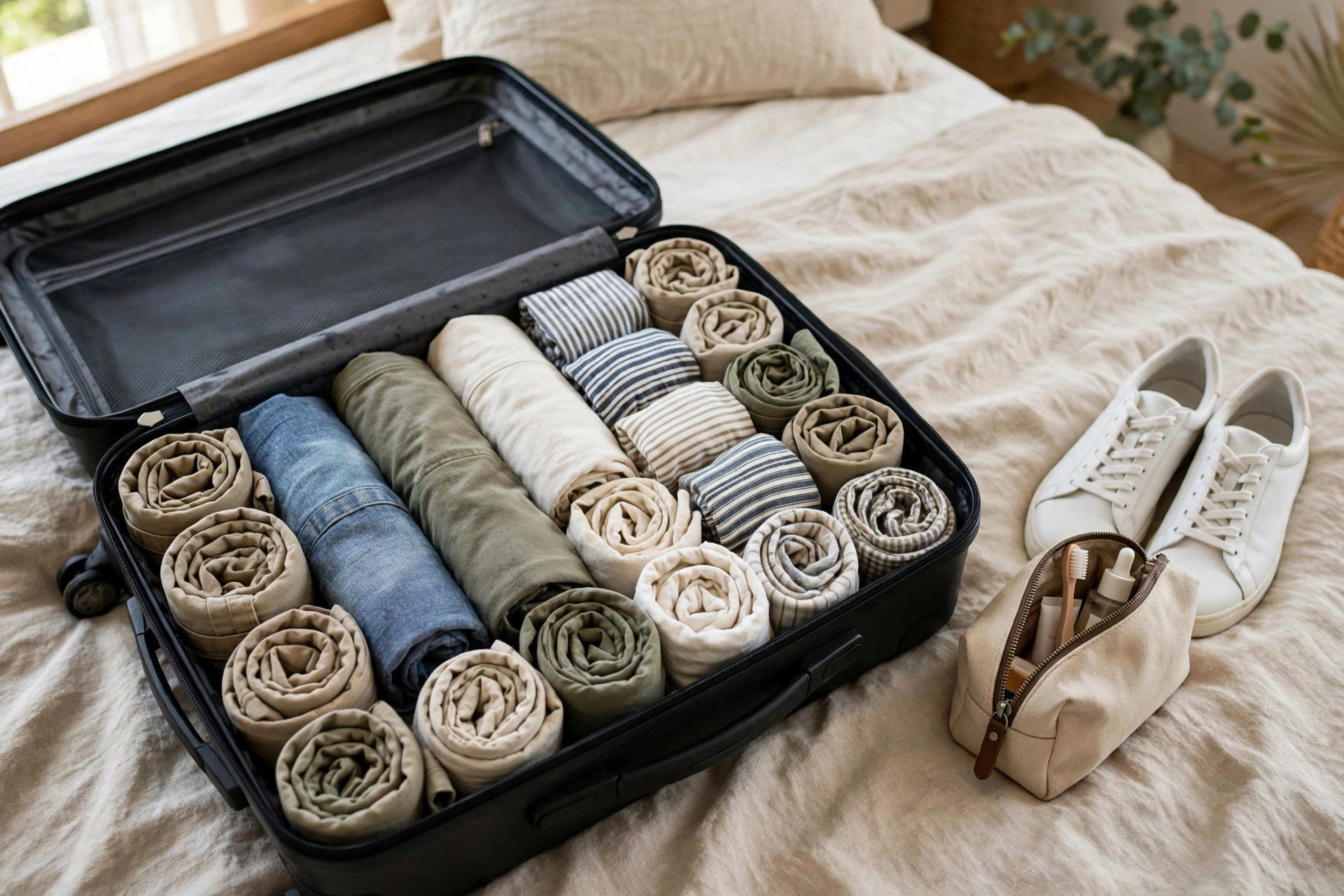
Rolling soft clothes such as T-shirts and knitwear does save space compared with folding them loosely, and it also makes wrinkles less noticeable. It works less well for stiff shirts and structured jackets, which are better folded flat on top of the rolled layers. Neither method creates space out of nothing, so do not expect a miracle — the real saving comes from packing fewer items, not from packing the same pile differently.
Packing cubes help you stay organised rather than magically shrinking your clothes. Use one cube for tops, one for bottoms, and a small one for underwear and socks, so you can pull out exactly what you need without unpacking the whole bag. Compression cubes squeeze out air and can help with bulky knitwear, but they also make it easy to overfill a bag until it is overweight — if you have to sit on it to close it, take something out.
Toiletries and Liquids Without the Bulk
Toiletries take up more room than most people expect, so this is where a carry-on trip is often won or lost. On most flights, liquids in hand luggage must be in containers of 100 millilitres or less, carried in a single clear resealable bag — check your airline and airport rules before you fly, because the details can vary. Decant shampoo, moisturiser, and sunscreen into small reusable bottles instead of carrying full-size ones, and consider solid alternatives: a shampoo bar, a solid deodorant, and a bar of soap take up less space, never leak, and do not count toward your liquids bag.
Skip anything your hotel already provides, such as a hair dryer or basic shower products, unless you know you need your own. Keep medicines and anything you cannot replace easily in your personal item, not in the overhead bin, so they stay with you even if your bag is gate-checked on a full flight.
Shoes, Tech, and the Things That Eat Space
Shoes are the single biggest space problem in a carry-on. Two pairs is a sensible limit for a week: the pair you wear for travelling, and one lighter pair for evenings or warmer days. Stuff socks and small items inside the spare pair to use the empty space, and put shoes in a bag or shower cap so they do not mark your clothes.
For tech, take one charger per device you genuinely need, and leave the extras at home. A single multi-port charger and one cable for each device usually covers a phone, earphones, and a tablet or laptop. Put cables and adapters in one small pouch so they are easy to find at security and do not tangle through your bag.
A Simple 7-Day Carry-On Checklist
Use this list as a starting point and adjust it for your weather and plans:
- Four tops in matching colours, two bottoms, one light jacket or cardigan
- Underwear and socks for seven days, plus sleepwear
- Two pairs of shoes, including the pair you wear on the plane
- Toiletries in travel-size containers, plus any medicines in your personal item
- Phone, charger, adapter, and earphones in one small pouch
- Passport or ID, booking details, and a payment card, kept in your personal item
- One scarf or shawl, sunglasses, and a small day bag or tote for daily outings
If your trip includes laundry — many hotels and apartments offer it — you can pack even less. Washing two tops halfway through the week turns a seven-day wardrobe into a four-day one, and that is often the difference between a bag that closes easily and one that does not.
Frequently Asked Questions
Can I really fit a week of clothes in a carry-on?
Yes, for most trips in mild weather, if you pack a capsule wardrobe where everything matches and you limit yourself to two pairs of shoes. Cold-weather trips with heavy coats and boots are harder, so wearing the bulkiest items on the plane matters even more.
What if the weather changes while I am away?
Pack layers rather than one heavy item for each possible forecast. A light waterproof layer and a warm mid-layer cover far more conditions than a single thick coat, and they pack smaller.
Do I need packing cubes?
No, but they help you stay organised, especially if you are moving between hotels. Rolling your clothes and packing by category works just as well if you prefer not to buy them.
Final Thoughts
Packing light is a decision you make before you open the suitcase, not a struggle with a zip that will not close. Choose a bag that fits your airline, build a small wardrobe where every piece earns its place, and pack outfits for the days you actually have planned. The reward is a trip that starts the moment you land: no carousel wait, no extra fee, and a bag you can lift into the overhead bin without a second thought.