
You are three hours into the drive, the hills opening up ahead of you and the road emptying out, when the battery gauge catches your eye. It reads lower than you expected, and the next town is still a long way off. That small jolt of worry is the one thing that keeps many drivers from taking their electric car on a long trip — and it is also the one thing a little planning removes completely. An electric road trip is not harder than a petrol one. It is simply planned differently: you think about energy before you leave, not when the tank runs low.
Start With Your Car’s Real Range, Not the Sticker Number
Every electric car has an official range figure, and almost no driver ever sees it on a real road trip. Motorway speeds, hills, cold weather, heating or air conditioning, and a loaded boot all eat into range. A car rated at 300 miles may comfortably deliver 220 to 240 on a fast highway run in winter. That is not a flaw — it is just physics — but your plan has to be built on the honest number, not the optimistic one.
Find your car’s realistic highway range before you plan anything. Your owner’s manual or the car’s own trip computer will guide you better than the brochure, and a short motorway test drive at your normal cruising speed tells you more than any figure on paper. Once you know that number, use a simple rule: never plan a leg longer than about 70 to 80 percent of your real range. The margin covers detours, headwinds, and the charger that turns out to be out of order.
Map Your Charging Stops Before You Leave
This is the single most important step, and it takes less than half an hour at home. Open a charging map — PlugShare, your car’s built-in navigation, or the US Department of Energy’s Alternative Fuels Data Center station locator — and plot your route. Mark every fast charger along the way, not just the ones you plan to use. You want options at every stage, so a closed or busy charger is an inconvenience, never a crisis.
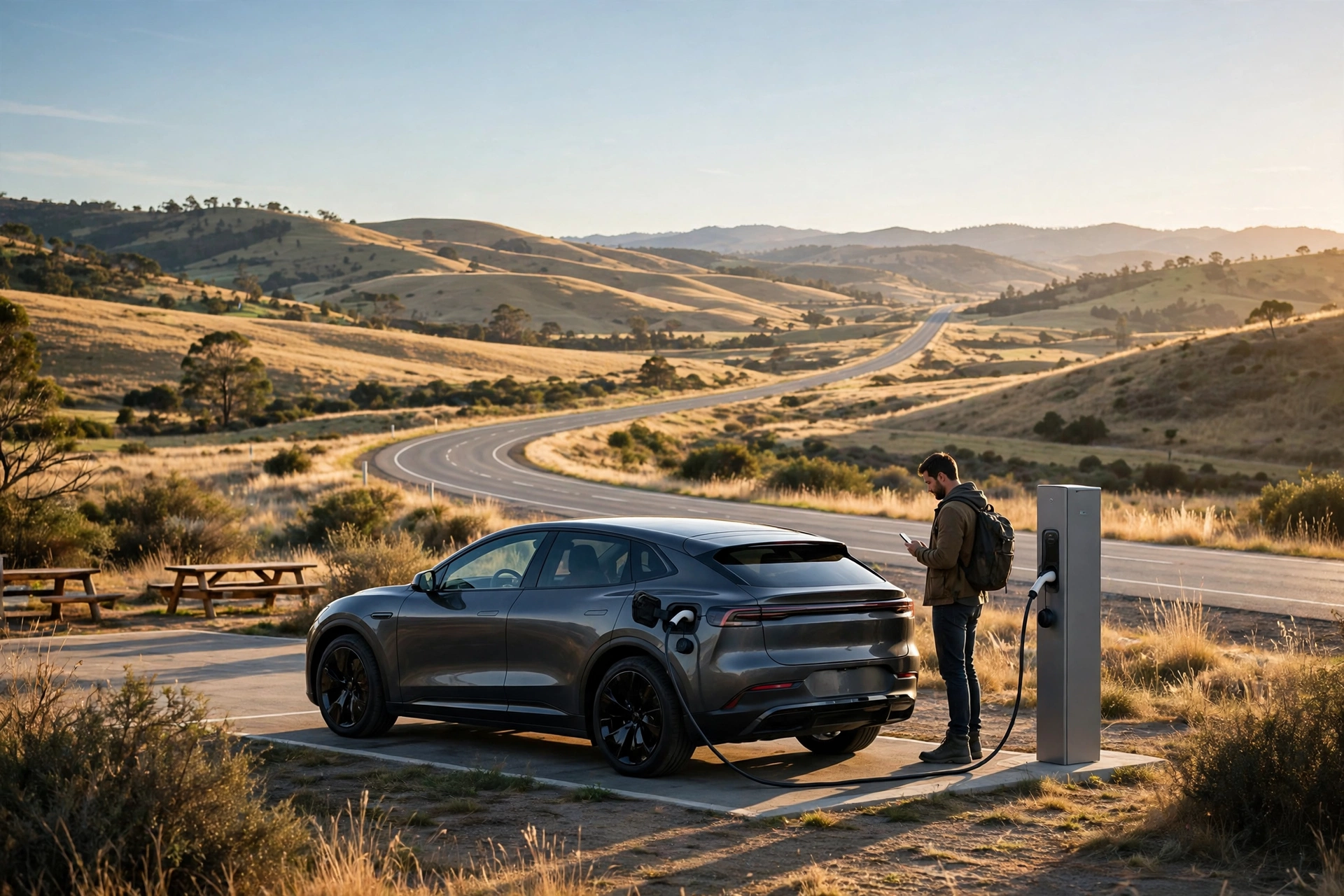
When choosing your stops, think about what is around each charger, not just its speed. A charger beside a cafe, a supermarket, or a park turns a 30-minute wait into a lunch break or a leg stretch. A charger in an empty lot turns the same wait into dead time. Pick stops you would actually enjoy, and the whole rhythm of the trip changes. A rough day-by-day plan, like the one in our guide to planning a 3 day itinerary for a first time visitor to a new city, works just as well for a driving holiday as it does for a city break.
Choose the Right Chargers Along the Way
Not all chargers are equal, and knowing the difference saves you hours. DC fast chargers are the ones built for road trips: they can take most modern electric cars from around 10 to 80 percent in roughly 20 to 40 minutes, depending on the car and the charger. Level 2 chargers, the kind you find at hotels, car parks, and shopping centres, are much slower — they are for topping up while you sleep or shop, not for a mid-drive stop.
Plan your route around DC fast chargers for the driving legs, and let Level 2 charging do the quiet work overnight. If your hotel has a charger, plug in when you arrive and wake up to a full battery — that alone can remove one fast-charging stop from the next day. Check the connector type fits your car, and check recent user reports on the charging app before you rely on a charger.
Build Charging Time Into Your Day
The biggest mindset shift on an electric road trip is accepting that charging time is part of the trip, not an interruption to it. Petrol drivers stop for fuel and drive on; electric drivers stop, charge, eat, rest, and drive on. The journey takes a little longer, but the driving is less tiring, because you take the regular breaks that road-safety experts recommend anyway.
A practical rhythm is a charging stop every two to two and a half hours of driving, lasting 20 to 35 minutes. That usually means arriving with 15 to 25 percent battery left and leaving at around 80 percent. Charging beyond 80 percent is slow — the last fifth of a battery fills far more slowly than the first — so unless you need the extra range for a long gap between chargers, unplug at 80 and keep moving. Over a full day, this pattern adds roughly an hour to an hour and a half compared with a petrol car.
Pack and Prepare for the EV Difference
Packing for an electric road trip has one extra item on the list: your charging kit. Carry your home charging cable and any adapters your car might need, and keep them somewhere you can reach without unpacking the whole boot. Download the apps for the charging networks on your route before you leave, and set up accounts and payment methods at home, where the Wi-Fi is reliable. The worst place to discover that an app needs a password reset is a rainy service station with one bar of signal.
Beyond that, the same packing logic applies as for any trip: less is more, and everything should earn its space. Our guide to packing light for a week-long trip with only a carry-on is written for flyers, but the principle holds in a car too — a lighter car uses less energy. Also check your tyres before you leave: correct tyre pressure improves range noticeably, and it is free to fix.
What to Do When a Charger Does Not Work
Even with good planning, you will one day pull up to a charger that refuses to cooperate. The screen is blank, the app will not start the session, or the plug is damaged. Do not panic, and do not waste half an hour fighting it. First, try the basics: unplug, wait a few seconds, plug in again, and try starting the session from the app instead of the charger screen, or the other way around. If another charger at the same site is free, move to it — a surprising number of faults affect one unit, not the whole site.
If the whole site is down, fall back to your backup plan: the next charger on your list, which is why you marked more than one. This is the moment your arrival buffer earns its keep — it gives you the range to reach the next stop without worry. Keep your roadside assistance number saved; running out of charge is no more dramatic than running out of petrol, and help will come to you.
Frequently Asked Questions
How far can you drive an electric car between charging stops?
A practical planning figure is 150 to 200 miles between fast-charging stops for most modern electric cars on a motorway. Plan each leg at 70 to 80 percent of your car’s real highway range, and you will always arrive with charge to spare.
Is it cheaper to take an electric car on a road trip than a petrol car?
Usually, yes — electricity per mile is generally cheaper than petrol, especially if you charge overnight at your hotel or at home before you leave. Motorway fast charging costs more than home charging, so check the per-kilowatt-hour prices on your route when you plan.
Can you road trip in an electric car in winter?
Yes, with a little more care. Cold weather reduces range, sometimes by a fifth or more. Pre-heat the car while it is still plugged in, use the heated seats rather than blasting the cabin heater, and shorten your planned legs on cold days.
Final Thoughts
An electric car road trip rewards the driver who plans a little and then relaxes completely. Know your real range, mark your chargers before you leave, and arrive at each stop with charge to spare. Do that, and the moment that worries every first-timer — the gauge dropping with miles still to go — simply never arrives.